
Solid Brass vs Zinc Alloy Cabinet Handles
When you are choosing handles and knobs for cabinets and drawers, the material decides more than the look. It sets the weight in your hand, the finishes open to you, how the hardware behaves if it is ever damaged, and what you pay per door across a whole kitchen. The three you will meet most often are solid brass, zinc alloy and aluminium — and they are not better and worse versions of each other.
We sell solid brass and we sell zinc alloy, so this is a comparison rather than a case for one of them. One thing is worth settling first: every piece of brass hardware we sell is finished rather than left bare. There is a protective layer over the metal and it is doing real work. What it does, and what it does not do, is where this starts.
1. A Protective Finish, Not Bare Brass
Brass is an alloy of copper and zinc. Left bare, it reacts with oxygen and moisture in the air and slowly darkens — that is tarnish, and it is the reason manufacturers put a finish on brass hardware in the first place. A protective coating sits between the brass and the air, so the metal underneath is not exposed the way bare brass is.
That slows the process down. It does not stop it. What the coating buys you is time, and how much time depends on the room, how often the handle is touched and what it is cleaned with. When a finished handle does start to look dull, it is usually a film of hand oil and cooking residue sitting on top of the coating rather than the metal changing underneath. Warm water and a soft cloth, dried properly, takes that film off. There is more detail in our guide to cleaning brass door handles.
2. Zinc Alloy vs Brass: What Actually Differs
This is the comparison most people are really making, so here it is without a thumb on the scale.
Zinc alloy is die-cast. That is why it costs less, and why it holds crisp detail — fluting, knurling and the tight radius on a cup pull all cast well, and some shapes are only practical as a casting. It is lighter in the hand.
It is also plated in many of the same finishes brass is — antique brass, gunmetal and brushed nickel run across both — so two handles side by side can look much the same.
The two lists are not identical, though. Across our cabinet handles and knobs, brass carries more finishes than zinc does, and brushed brass is one that only the brass ranges have. We stock several ranges in zinc or zinc-aluminium alloy — see our more affordable ranges.
Solid brass is heavier for the same shape, and the metal is the same the whole way through: a scratch that goes past the finish exposes brass, not a different metal. Whether that reads as wear or as damage depends on the finish over it — brushed brass is the brass itself under clear lacquer, while antique brass, gunmetal and brushed nickel are electroplated over it.
It costs more than the zinc-alloy equivalent, though the two price ranges overlap in the middle — a long zinc handle can cost more than a small brass knob, so price alone will not decide it for you.
Aluminium is the lightest of the three and resists corrosion well, which is why it turns up so often in commercial, sliding-door and outdoor hardware. It extrudes easily into long, slim profiles. An anodised colour is a surface layer with the same caveat as plating.
The one difference that shows up in daily life is what happens if the finish is ever breached — a deep scratch, or wear at the exact spot fingers land. On brushed brass, what shows through is more of the same brass, and it reads as wear rather than damage; on zinc alloy it is a dull grey that does not blend back in.
On a plated finish it goes the other way. A deep scratch in antique brass, gunmetal or brushed nickel shows yellow brass against a darker or greyer surface, so it stands out rather than blending in — on those three, brass holds no advantage here. Either way it is a repairability difference, not a verdict on quality: in plenty of homes it simply never comes up.
How we would choose. Brass for the doors and drawers opened many times a day — kitchen drawers, a pantry, a wardrobe you use every morning — where weight and the feel of the action are part of what you are paying for.
Zinc alloy where a cast shape is the design, where the door is opened occasionally, or where the budget has to stretch across thirty doors. Both are honest answers to different questions. Check the material stated on the product page for the range you are looking at, and ask us if it is not there.
3. Timeless Elegance
Brass suits both modern and traditional cabinetry, and that is why it keeps coming back into fashion long after other finishes have been and gone. What sets the tone in a room is the finish you choose rather than the metal itself.

Are you looking for this: Geo Brass Handles
4. Corrosion and Tarnishing
Brass resists corrosion well on its own, and the protective coating on a finished handle adds a second barrier on top of that. This matters most in humid rooms and anywhere the hardware meets cooking steam or cleaning sprays. It is a delay, not an exemption — a coating can eventually wear through at the point your fingers land most often, and that patch will darken where the rest of the handle has not.
5. The Weight Factor
Solid brass handles are heavier than zinc alloy or aluminium ones of the same size, and that weight is the difference most people notice first when they pick one up. Whether it matters is a question of taste and of where the handle is going: a heavy pull on a daily kitchen drawer feels substantial, while the same weight on a light overhead door is simply extra load on the hinge.
6. Recyclable at End of Life
Brass, zinc alloy and aluminium are all recyclable, so none of them is a poor environmental choice on material grounds alone. The bigger variable is how long the hardware stays on the door: a handle that is still there in ten years has already beaten one that was replaced twice.
7. Design Versatility
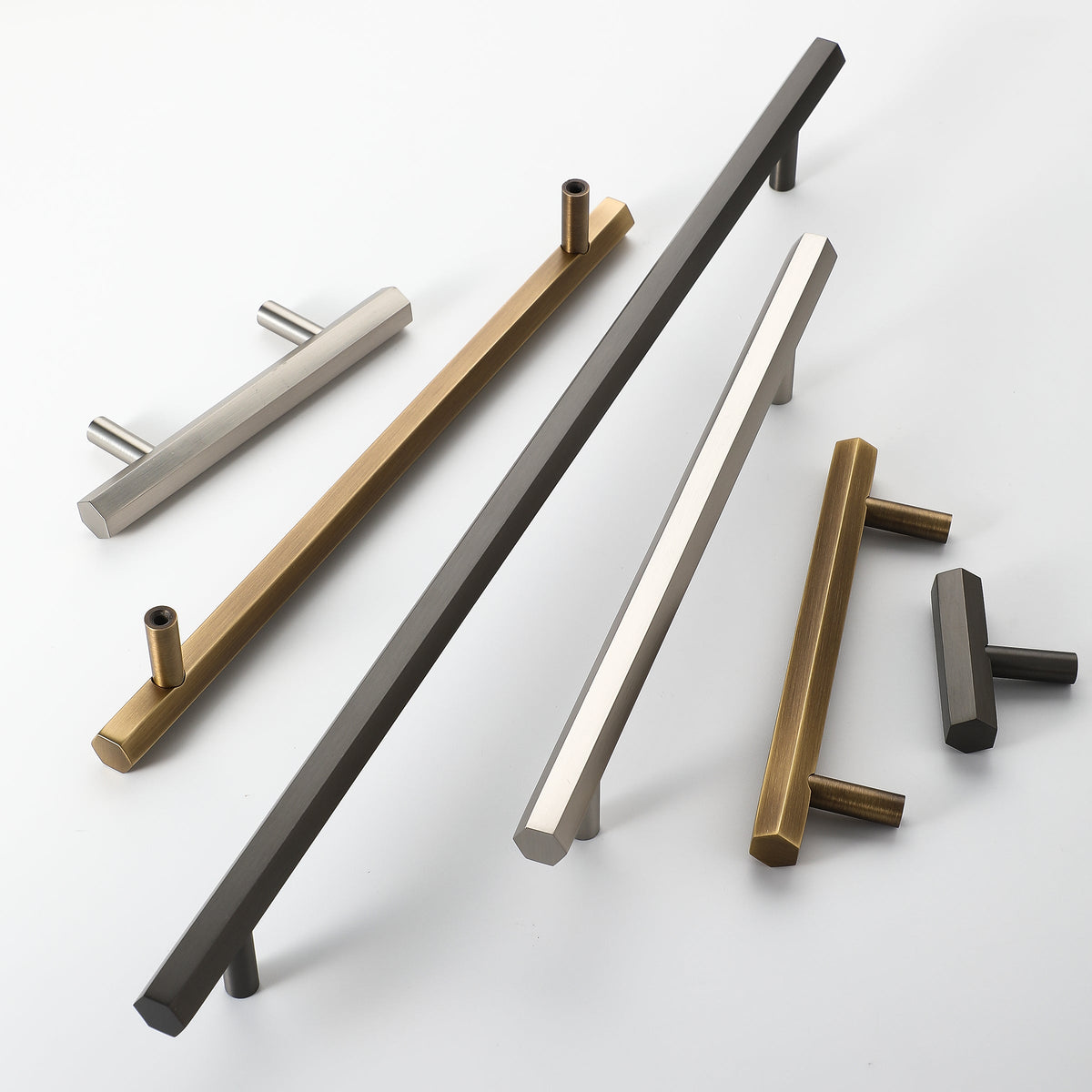
Solid brass takes a wide range of finishes, so one profile can suit very different kitchens. The Geo profile is made in four — brushed brass, antique brass, gunmetal and brushed nickel — bright and warm at one end, dark and matte at the other, with the shape unchanged.
Three of those — antique brass, gunmetal and brushed nickel — are electroplated over the brass. They wear the way any plating does: a deep scratch shows the yellow brass underneath rather than blending in. If that matters to you, brushed brass is the one that blends back in.
Sizing matters as much as material once you have chosen. Our drawer handle size guide covers fixing centres, proportion and placement.
In short: solid brass with a well-applied protective coating is a strong choice for cabinet handles and knobs, and it earns that on weight, on how brushed brass behaves when it is damaged, and on the range of finishes it takes. Zinc alloy is the sensible answer when a cast shape or a budget is doing the deciding, and we stock it for exactly that reason. Browse our cabinet handles and cabinet knobs, or ask us which material a particular range is made from.

Written by sui yi lee


